
This page provides an overview of the most common spiders found in the United States. For a more detailed overview of spiders in the U.S. by state, check out USASpiders.com
Table of Contents
NOT DANGEROUS – i.e MAY BITE BUT NOT LIFE THREATENING
All spiders can and will bite if in danger or accidentally touched e.g. in shoes or clothing etc. Any spider bite can cause a reaction, ranging from a bee or wasp sting type bite to those requiring hospitalisation. Different people react in different ways, so if you see a spider it is best to be cautious and look but do not handle any spider no matter how it is classified.
WEB SPINNING SPIDERS
Garden Orb Weaver – Neoscona crucifera
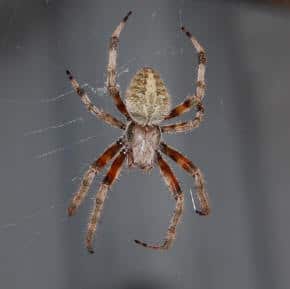
The family is a large one, including over 2800 species in over 160 genera. New species are still being discovered. Orb weavers (Araneidae) are often brightly coloured with rounded abdomens, some with peculiarly angled humps or spines. However, there is considerable variation in size, colour and shape in this group. They are often recognized for building beautiful, large, round webs, on which they rest, head downward, waiting for prey. The webs consist of a number of radiating threads crossed by two spirals. The inner spiral begins in the centre, winds outward, and is made of smooth threads like the radiating threads. It covers only the central 1/3 of the web. The outer spiral begins at the edges and winds inward. It is made of more elastic, sticky threads, coated with a liquid substance. The life span of these spiders is short, only lasting one season
Marbled Orb Weaver – Araneus marmoreus
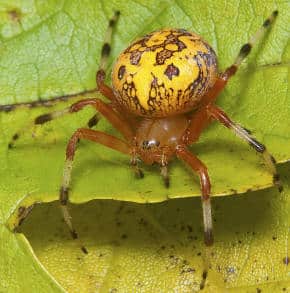
Orb weavers are known for their bright colours. They build large, round webs and wait with for their prey with their head facing down. The abdomen is often rounded. The Marbled Orb Weaver is common in urban areas and is over 1/2 inch long.
Silver Argiope- Argiope argentata
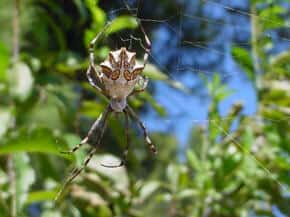
The male grows to 1/8-1/4″ (4-5 mm), and the female 1/2-5/8″ (12-16 mm). They have silvery short hair on upper surface of female’s cephalothorax and 1st abdominal segment. Most of the abdomen is black to brownish yellow with silver spots. Underneath is also black to yellow-brown. Legs are blackish brown to yellow with 2 pale bands and black hair. They make the same zigzag cross strands forming X-shaped mark at centre, measuring to 32″ (81 cm) across as the Black and Yellow Argiope. Primarily a spider found in tropical regions of the New World, this species is able to survive frost only when very young and seldom is found in the North.
Jewel Spiders – Gasteracantha Minax
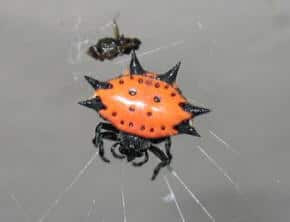
They are also known as spiny orb weavers and are part of the orb weaving spider family. This spider’s body is very broad and grows to the size of a 20c piece, with its 8 legs being the length of a pin (fairly short for a spider). Its abdomen is strikingly coloured with bright yellow and white and black. Six stout spines (long and sharp) come from the border of the abdomen.
Venusta Orchard Spider – Leucauge venusta
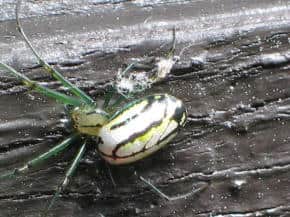
The male growsato 1/8″ (3-4 mm), and the female 1/4-3/8″ (5-8 mm). Its cephalothorax is yellowish green, striped with brown along sides. The abdomen is silvery above with dark stripes, sides yellow with red spot near tip and red spot underneath. This spider clings below its web or to a nearby twig until prey blunders into the web and shakes it. They live in Maine to Florida, west to Nebraska and Texas.
Southern House Spider – Kukulcania hibernalis
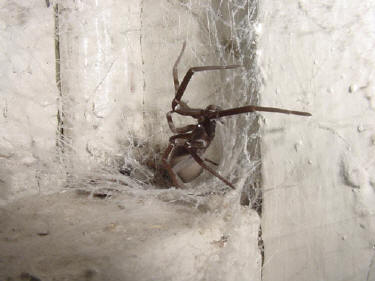
The Southern House Spider is relatively large and has a distinctive flat, tangled web. It is common throughout Florida and much of the southern United States in human populated areas. Males of this species are often mistaken for the notorious brown recluse spider, Loxosceles reclusa, because of their colour and general shape. Southern house spiders are not known to have a dangerous bite. However, some cases reportedly caused the victims pain and swelling for a few days.
Golden Silk Orb Weaver – Nephila clavipes
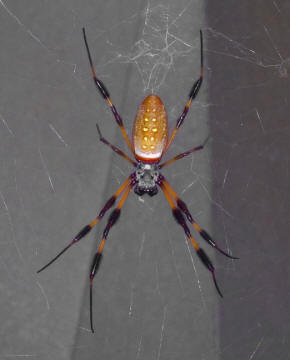
The Golden Orb Weavers build large, semi-permanent orb webs. The strong silk has a golden sheen. These spiders remain in their webs day and night and gain some protection from bird attack by the presence of a ‘barrier network’ of threads on one or both sides of the orb web. Sometimes their strong webs manage to trap small birds or bats, and the spider will wrap them and feed upon them. Commoner prey items include flies, beetles, locusts, wood moths and cicadas. Golden Silk Orb Weavers are large spiders (body 2-4 cm) with silvery-grey to plum coloured bodies and brown-black, often yellow banded legs. The males are tiny (5 mm) and red-brown to brown in colour. This spider belongs to the Tetragnathidae (longjawed orbweavers) family.
Nephila clavipes is the only species in the Nephila genus that exists in the USA.
Black and Yellow Argiope – Argiope Aurantia
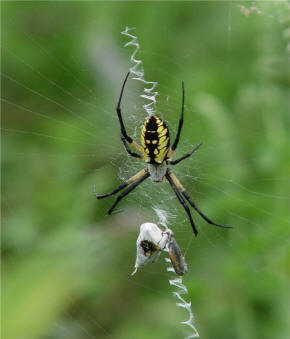
This lovely spider only has a short life span and once she has produced one or more (usually no more than 3) brown, papery egg sacs, she will die. The egg sacs are roughly round in shape and up to 25 mm in diameter; each contains 300 to 1400 eggs. She attaches her egg sacs to one side of her web, close to her resting position at the centre. Each female will watch over her eggs as long as she can, but will die in the first hard frost, if not before. The eggs hatch in Autumn ( fall), but spiderlings stay in the sac during winter and emerge in spring. There is also a silver argiope which differs in that it has a metallic silver back.
Spiny micrathena – Araneidae Micrathena sagittata
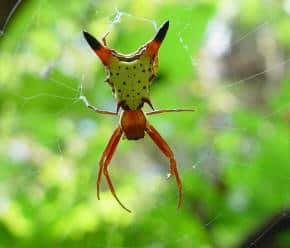
The genus Micrathena contains over 100 species of mostly Neotropical woodland orb-weavers (Levi 1985). M. gracilis is found in dense deciduous forests in eastern North America south to Costa Rica. Males do not construct webs after attaining sexual maturity. The female’s web is a small orb, 3.0 – 7.5 inches in diameter, typically three to seven feet above the ground in the understory.
Bolas Spider Mastophora cornigera
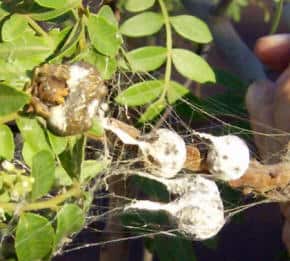
The female Bolas spider is inactive during the day, although she can often be found in fairly exposed places. The male is much smaller than the female. Shortly after dusk, the spider lowers herself on silk threads, spins a silk line with a sticky blob on the end of it and swings it to catch the moths or other insects that have been attracted by chemicals. The spider gets its name from the bolas (ball-on-a-string) weapon used by Eskimos and South American Indians.
Funnel Weaver Spider – Agelenopis species
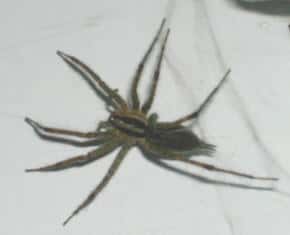
Funnel Weaver Spiders are often mistaken for Wolf Spiders but the Funnel Weavers construct large, flat, horizontal webs of non sticky silk and Wolf Spiders do not spin webs. The web contains a funnel at one end that serves as the spider’s retreat. The funnel is open at both ends so the spider can readily escape. The spider hides at the narrow end of the funnel; when it feels the vibration of an insect crossing the web, it dashes out, bites the insect, then carries it back to the funnel. Funnel Weavers and grass spiders are usually lighter in build than wolf spiders. Many common funnel weaver and grass spiders are also characterised by having very bristly legs. Most are brown, with grey, black, and tan markings. Some have banded legs and some have long spinnerets that extend out beneath the rear of the abdomen. They will only bite if provoked, and are not considered dangerous. Their bites are not known to be very toxic to humans.
Shamrock Orb Weaver – Araneus trifolium
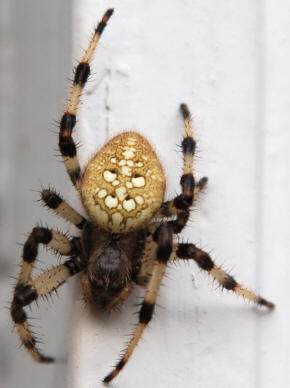
Orb Weaving Spiders are common spiders with poor vision which build beautiful, complex-looking webs all over the world. The shamrock spider is a familiar member of the family and is distinguished by the markings on its back and black markings on its legs.
Banded Argiope- Argiope trifasciata
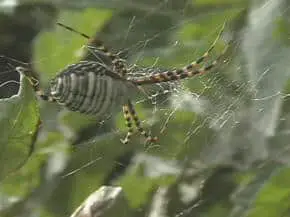
Banded Orb-weaving Spider females have yellow, white and brown coloured bands across their abdomen Their head/thorax has silver hair. The legs are hairy, and often banded. The males look the same, but are much smaller than the female. Banded Orb-weaving Spiders build vertical orb webs and are active both day and night. They make stabilimentum on their web too, but may not make it like a cross. Banded Argiope are common throughout most of the US. They can often be found building webs side by side with the Black and Yellow Argiope but the Banded Argiope tends to favor slightly drier habitats. The female spins a silken hemispherical egg sac.
Common House Spider – Parasteatoda tepidariorum
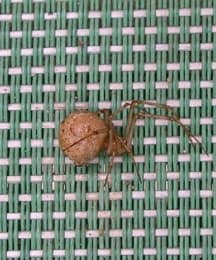
The House Spider builds large webs in the corners of rooms, under bedroom furniture and furniture in other rooms, in angles between fences, and often between stones. They build where they can find the most prey. They can be found during any season. The colour varies from a dirty white to almost black. The cephalothorax is yellow brown and the legs are light yellow with brown or grey rings at the ends and middle of the joints. The females usually range from 5 to 6 mm long and the males 3.8 to 4.7 mm . The female lays her eggs in a brownish, pear shaped cocoon that is 6 to 9 mm in diameter.
Nursery Web Spider – Pisaurina mira
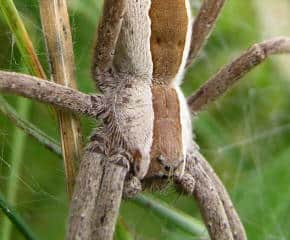
These spiders resemble the Wolf Spiders (Lycosidae), but have a different eye pattern. Pisaurids have their eyes arranged in 2 rows, the posterior row slightly recurved, the median eyes in the second row slightly (if any) larger than the others. (Wolf spiders have eyes arranged in 3 rows). The egg sac is carried by the female under her prosoma, held there by her chelicerae and pedipalps. Before the eggs hatch, the female attaches the sac to a plant and then bulds a web around it — and stands guard nearby. The Pisaurids forage for their food and build webs only for protecting their young. Photo – Sue Taylor
Daddy Long Legs -Pholcus phalangioides
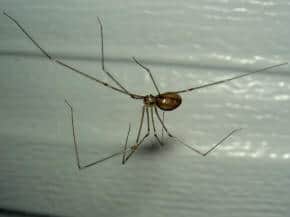
People often confuse the Daddy Long Legs with the long legged Harvestmen (Phalangium opili) which are also called Daddy Long Legs but if you look closely at the Harvestman you can see that its head, thorax and abdomen is fused, therefore it is not really a spider. Pholcus phalangioides is found world wide. Their webs are messy structures in corners where the spider resides on the lower side hanging downwards. Anything that touches the net is attacked and taken for prey if it’s not too big. They feed on insects but are also known to invade other spider’s webs and attack the original inhabitants. They then use their web to catch prey. Daddy Long Legs have a reputation for being the most venomous spider, probably because they have been know to kill Black Widows and Tegenaria species, however this has not been proven. Daddy-Long-Legs spiders have venom glands and tiny fangs and while commonly thought not to bite humans, have been reported as doing so.
HUNTING SPIDERS
Wolf Spiders – Lyosidae, Genus Lycosidae
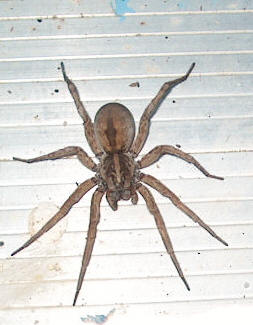
The Wolf Spider got its name because it stalks its prey like a wild dog. It is an open range hunting spider. The female grows to 35mm and the male to 20mm. They are a small to medium size spider. They can be grey or brown with marking on their back which can be black, orange, grey or brown. The Wolf Spider has three rows of eyes, two at the back, two in the centre and four in the front. It is distinctive in the way it carries its young on its back. The Wolf Spider is not an aggressive spider. If the spider is handled, it can cause a painful bite which may cause infection and skin lesions in some people. Females carry their babies on their backs. Click here for photos.
Fishing Spiders – genus Dolomedes
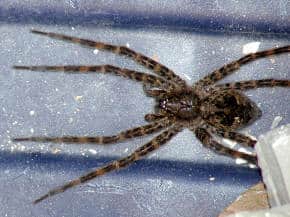
Fishing Spiders are quite large and may have a leg spread of 75 mm or more. Fishing spiders are hairy, large, and usually a mixture of black, brown, and grey. Although very difficult to distinguish from wolf spiders, nursery web and fishing spiders are usually slimmer in build. The Dolomedes spiders live near water; they walk on the surface of water and dive underneath it to feed on aquatic insects and even small fish. Not all fishing spiders live near water however.
Tarantula – Genus Aphonopelma
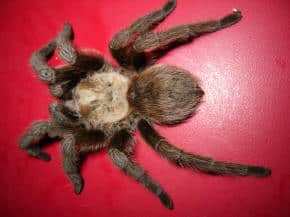
A Tarantula is a hairy, long-legged, long-lived spider found mostly in warm regions. Also sometimes known as Bird Spiders or Monkey Spiders, true Tarantulas make up the family Theraphosidae; related forms, including Funnel-web Spiders and Trap door Spiders, are also sometimes grouped as Tarantulas. Many species are about 2.5 to 7.5 cm (1 to 3 in) long, with a 13-cm (5-in) leg span, but some South American species are larger. Tarantulas are often kept as pets and some in captivity have been known to live for as long as 20 years. Tarantulas inject a paralysing venom into prey with their large fangs. Their bite is unlikely to cause problems other than pain at the site. Skin exposure to the urticating hairs will cause itching and a rash.
Trapdoor Spiders
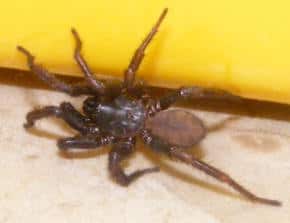
The name Trapdoor Spider scientifically covers several families and many different species. The Trapdoor spider family worldwide, include the Funnel-web, Mouse, Whistling, and Curtain-web spiders; they are distinguished by the stocky body, long leg-like palps, and two knee-like lobes to which the fangs join (chelicerae) in front. However the spider called Trapdoor in the USA is usually harmless to humans and the male is often found around homes and swimming pools in its travels looking for a mate.
Jumping Spiders
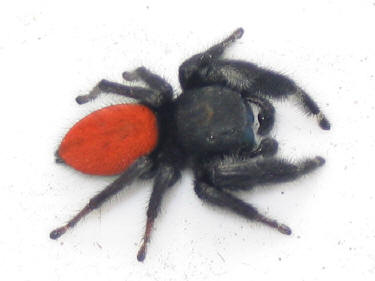
The Jumping Spider is a diurnal animal with excellent eyesight, that pursues its prey and leaps upon it. It has an all-round view of its surroundings because of its large, central, front eyes. It is about the size of a 20c piece when fully grown, with pin size legs. There are many different species but all jump and turn their heads separately from their bodies to look at objects. They live in houses and gardens and are most common in Summer, Australia wide. It is a roving spider but hangs from web lines at night. It rarely bites people and causes only mild local pain.
Camel Spider – Solfugids
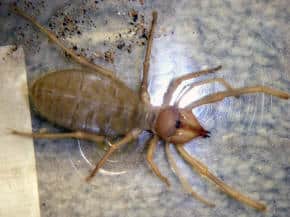
Also known as Sun Spiders or Windscorpions, these strange looking spiders were recently reported as being dangerous to the soldiers in Iraq. The USA version is somewhat smaller than that specimen but is quite often sent in to me for identifying. They live in tropical or subtropical dry areas of the Americas, Asia, and Africa. Worldwide, there are about 900 known species of Wind Scorpions, and in North America there are 120. Most species of Wind Scorpion are actually nocturnal, but they are often attracted to light. Apparently authentic cases of after effects resulting from a solfugid bite have been recorded, but these symptoms were probably caused by bacterial infection of the wound as poison glands have not been found to be associated with the chelicerae.
Green Lynx Spider – Peucetia viridans
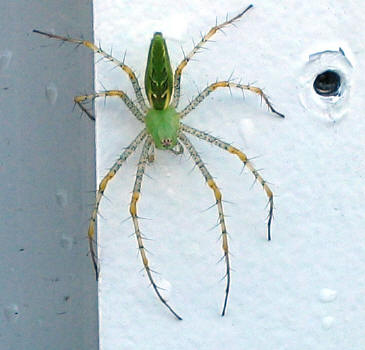
Lynx spiders get their name from the way that they sometimes pounce on their prey in a catlike fashion. These spiders spend their time hunting for insects in bushes and low plants. They are fast runners, but can occasionally be seen lying in wait for prey beside flowers. They build no web for prey capture, but they do release a silk dragline as they hunt among leaves. While the Green Lynx spider aggressively attacks its insect prey, it very seldom bites humans.
Huntsman Spider – Heteropoda venatoria
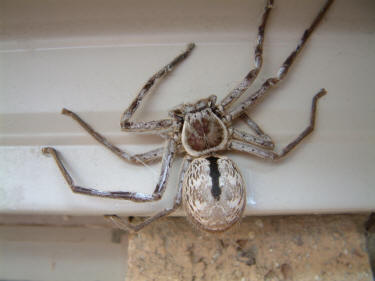
Huntsman Spiders are those long-legged spiders we often surprise crawling around our ceilings at night. They are part of the “modern” spider species which breathe through trachea as well as through “book-lungs”. They also have chelicerae which close side to side. The legs of a huntsman spider fan out sideways and the joints bend forwards. This means these spiders can run sideways as well as forwards – useful under bark and among stones.
Flower Crab Spider – Thomisus spectabilis
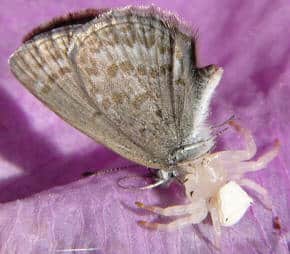
Another name for the Flower Spider is the Crab Spider because it has white or yellow stout legs which are held like a crab. The full size of the Flower Spider is between four and ten millimetres. Flower Spiders are often white or yellow in colour, some have green, brown or rosy tints on the abdomen. The females are small and their legs are less than 7mm long. The males are even smaller, but their legs are longer. They normally have two large front eyes and have very well developed eyesight. One species of crab spider is the Goldenrod Spider.
Parson Spider
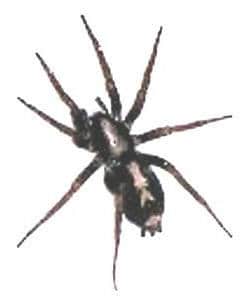
The parson spider is a nuisance in homes and is generally non-toxic; although some people may experience allergic reactions to the bites. The parson spider is about 1/2 inch long and may vary in colour from brown to black. The front segment of the body tends to be a chestnut colour, while the abdomen is greyish with a distinctive white or pink pattern along its middle. The body is covered with fine hairs, giving a velvety appearance. The parson spider is usually found outdoors under rocks or in piles of brush or firewood. This spider does not spin a web, but wanders on the ground in search of prey. Indoors, this spider wanders about at night and conceals itself beneath objects or in clothing during the day. Most bites from this spider occur at night or when it is trapped in clothing. While the parson spider is not considered venomous, bite symptoms are variable in severity. Some people may experience localized allergic swelling and itching in addition to initial pain. A few persons may experience excessive swelling, nervousness, nausea, sweating and elevated temperatures from the bites.
DANGEROUS – MAY BITE AND COULD BE LIFE THREATENING
The spiders listed below have been known to cause death or give bites that are classed as dangerous or life-threatening. However, there is an antivenin available for the Black Widow which is the spider most likely to have caused deaths in the United States. Click here for a map showing the location of some of the dangerous spiders found in the USA.
WEB SPINNING SPIDERS
Black Widow – Latrodectus mactans & Latrodectus variolus
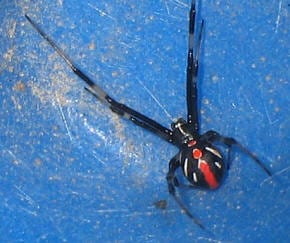
The black widow is one of the most commercially popular spiders and is a favourite Halloween costume for trick-or-treaters in the U.S. Widow spiders belong to the family of comb footed spiders (Family Therididae). The female, about 1.3 cm (0.5 in) long, is glossy black, densely clothed with microscopic hairs, and marked with a characteristic red hourglass on the underside of the abdomen.
The male, which is rarely seen, is smaller than the female and has four pairs of red marks along the sides of the abdomen. The Black Widow is found in the warmer regions in every state in the United States except Alaska; it lives in a variety of natural and domestic habitats. The venomous bite of the Black Widow Spider, causes muscle spasms and breathing difficulty in humans and may be fatal. Black Widows comprise about six species and inhabit most of the warmer regions of the world to a latitude of about 45 degrees N. The female black widow spider, though it is the most venomous spider in North America, seldom causes death as it injects a very small amount of poison when it bites. Reports indicate human mortality at well less than 1% from black widow spider bites.
Brown Widow – Lactrodectus geometricus
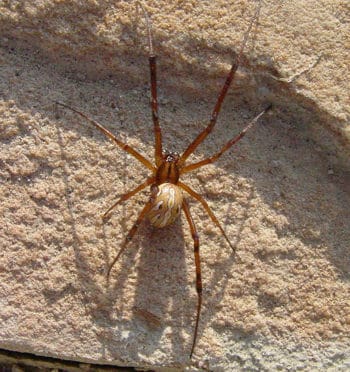
The Brown Widow is of the same group as the Red-back and the Black Widow but its toxin is about one-tenth the strength of the Red-back toxin and does not cause the same severe reaction. Brown Widow Spiders usually curl up into a ball, and drop to the ground as a primary defense. The Brown Widow Spider is one of the species with the infamous “red hourglass” marking on the underside of its abdomen.
Only the females are dangerous when it comes to any species of widow spider. It is an introduced species in the United States and is found mainly in the tropical states. According to Dr. G.B. Edwards, an arachnologist with the Florida State Collection of Arthropods in Gainesville, the brown widow venom is twice as potent as black widow venom. However, they do not inject as much venom as a black widow, are very timid, and do not defend their web. The brown widow is also slightly smaller than the black widow.
False Widow – Steatoda nobilis
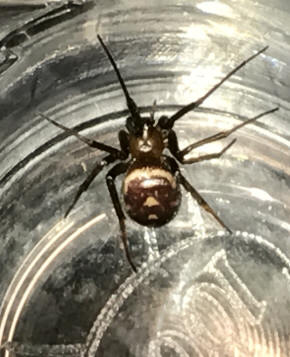
Steatoda nobilis is a spider in the genus Steatoda, known in the United Kingdom as the noble false widow and often referred to as the false widow.[a] As the common name indicates, the spider superficially resembles and is frequently confused for the black widow and other spiders in the genus Latrodectus, which can have medically significant venom. Steatoda nobilis is native to Madeira and the Canary Islands from where it allegedly spread to Europe, and arrived in England before 1879, perhaps through cargo sent to Torquay. In England it has a reputation as one of the few local spider species which is capable of inflicting a painful bite to humans, with most bites resulting in symptoms similar to a bee or wasp sting. It has also been found in California and Chile.
HUNTING SPIDERS
Broad Faced Sac Spider
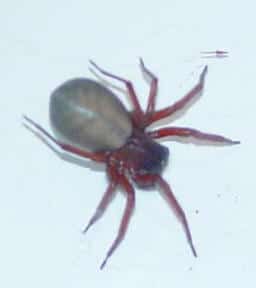
The broad face sac spider, trachelas tranquillus, is often confused with the woodlouse hunter, being similar in shape & colour. Its abdomen is more sac shaped however and is a light yellow/grey with a darker marking on the dorsal side. This is a hunting spider so it makes no web. However, it builds a sac like tube to hid and rest in diurnally which is also used to protect its eggs in autumn. This spider tends to forage on other dead arachnids and insects which can cause its bite to be particularly unpleasant due to infections.
Hobo Spider – Eratigena agrestis
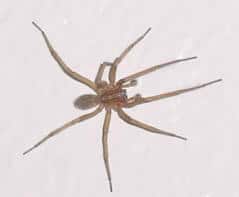
The Hobo Spider is a moderately large spider which was originally native to western Europe and was introduced into the north western United States (Port of Seattle) sometime before the 1930’s. This large brown spider has a chevron pattern on the abdomen and is commonly seen running across floors. The Hobo is especially active July to September, when males search for females. Many bites previously attributed to the Brown Recluse Spider are now thought to be caused by the Hobo Spider. It is now acknowledged as being the leading cause of serious envenomation (tegenarism) in the northwestern United States. However not all bites result in necrotic arachnidism in many cases the bites are “dry”, and no venom is injected .
Yellow Sac Spider – Cheiracanthium inclusum
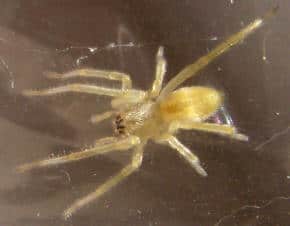
Yellow Sac Spiders are relatively small (10 mm body length), and are yellowish in color; they are difficult to distinguish from one another. Bites generally produce instant, intense stinging pain, not unlike that of the sting of a wasp or hornet. This may be followed by localised redness, swelling and itching; these manifestations may or may not evolve into a necrotic lesion, but when that occurs healing is usually complete within eight weeks. Side effects may include chills, fever, headache, dizziness, nausea, anorexia, and sometimes shock.
Brazilian Wandering Spider – Phoneutria fera
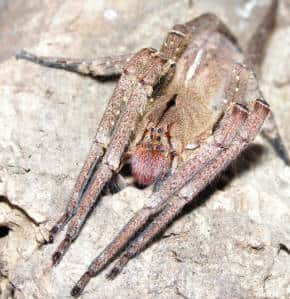
The Brazilian Wandering Spider are very fast, highly venomous, and extremely aggressive and is thought to be among the most venomous spiders known. Recent studies however have found that it only injects venom in about one-third of its bites and may only inject a small amount in another third. Therefore the effects of the bites from this spider can range from only a couple of pin pricks to a full dose of its poison. In South America, these spiders are often encountered in peoples’ homes, hiding in shoes, hats, and other clothes. It wanders the forest floor, which is how it got its name. The Brazilian Wandering Spider also is called the Banana Spider because there have been cases where these spiders have appeared on banana boats heading for the United States.
Brown Recluse – Loxosceles reclusa
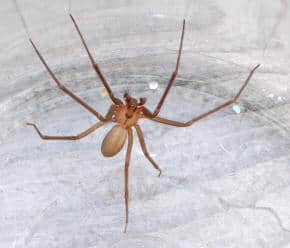
The Brown Recluse spider (Loxosceles reclusa) is a member of the “brown” spider family, Loxoscelidae. They are light in colour and about 7mm long; their six eyes are arranged in two rows. They are easily identified by the distinctive dark violin-shaped design on its lighter upper abdomen. They are most common in the western and southern United States. A few species of Brown Recluse are harmful to man – including the brown recluse, which occurs in the United States and Chile. When bitten, a blister arises around the area of the bite. The local pain becomes intense with the wound sloughing tissue (loxoscelism) often down to the bone. Healing takes place slowly and may take 6 to 8 weeks. If the bite of a brown recluse spider is suspected, collect the spider and consult a physician immediately.