
Spiders are small, eight-legged creatures that are best known for spinning silk webs. Spiders spin webs so they can catch insects for their food and even larger and stronger insects cannot escape. All spiders spin silk but some don’t spin webs. Bolas spiders spin a single line with a sticky end. Any insect near, gets trapped when the spider swings the sticky line near them. All spiders have fangs and most kinds have venom glands. They use their fangs and venom glands to capture their food. A spider’s bite can kill insects and other small animals. A few kinds of spiders are harmful to human beings. In North America, six kinds of spiders harm people, they are – the Brown Recluse, Sac, Black Widow, Brown Widow, Red-legged Widow and the Varied Widow. Four of the Widow females are known to bite humans.
Table of Contents
Spider Information
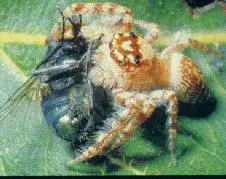
The bites of these six spiders often cause mild reactions. Usually a person irritates a spider several times for it to bite you. In Australia, the most dangerous spider is the Funnel-Web with the Red-back, a type of Black Widow spider, also being dangerous.
Spiders are helpful to people because they eat harmful insects. They eat grasshoppers and locusts which destroy crops. Spiders also eat flies and mosquitoes which carry diseases. Spiders feed mostly on insects but some capture and eat tadpoles, small frogs, small fish and mice. Most females are larger and stronger than the males and occasionally they eat males.
Spiders can live anywhere they can find food like fields, woods, swamps, caves and deserts. One kind of spider spends most of its life underwater. Another kind lives near the top of Mount Everest, the world’s highest mountain. Some live in houses, barns, and other buildings. Others live on the outside of buildings, on walls, windscreens and corners of doors and windows.
The life span of arachnids in temperate areas is a single season, therefore they rely on eggs to perpetuate the species from year to year. In warm regions, certain groups (some scorpions and tarantulas) appear to live more than a single year, in fact some tarantulas in captivity have survived for as long as 20 years.
There are more than 30,000 kinds of spiders. Scientists believe there may be up to 50,000 to 100,000 kinds. Some are smaller than than the head of a pin but some are larger than a person’s hand. One kind of spider, a South American tarantula is measured at 25 centimetres but that is with its legs extended.
Most people think spiders are insects but scientists classify spiders as arachnids. Insects are different in a number of ways. Spiders have eight legs but ants, bees, beetles and other insects have only six legs. Most insects have wings or antennae which are feelers. Arachnids include daddy long legs, scorpions, mites and ticks.
Scientists classify spiders as either true spiders or Tarantulas, according to certain differences in their bodies such as the way their fangs point and move. In addition, spiders can be grouped according to the way they live. Web spinning spiders spin webs to catch insects. Others lie and wait for insects to come.Spiders’ Bodies.
Spiders may be all different shapes – short and fat, long and thin, round, oblong, or flat and one even looks like a stick insect. Their legs can be short and stubby, or long and thin. Spiders are most commonly brown, grey, or black but some species have beautiful colours. Many of these spiders are so small that their colours can be only seen with a microscope.A spider has no bones and its tough skin serves as a protective outer skeleton. Hairs, humps, and spines (bristles of skin) cover the bodies of most spiders.A spider’s body has two main sections: the cephalothorax, which consists of the head joined to the thorax (chest); and the abdomen. Each of these sections has parts attached to it called appendages Connecting the the cephalothorax and the abdomen is a thin waist called the pedicel.
Ears
A spider does not have ears. Mammals hear with help of hairs that are located in the ear where pressure waves in the air are converted to electric signals. These signals are then sent to the brain and interpreted as sound. A spider hears with very tiny hairs on her legs (thrichobotria). She is very capable of localizing the origin of a sound by interpreting the movement of the air produced by that sound.rs
Eyes
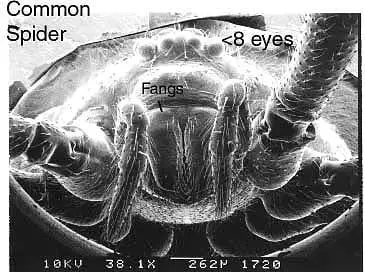
A spider’s eyes are on top and near the front of its head. Different species have different numbers of eyes and the size and position also varies. Most species have eight eyes, arranged in two rows of four each. Other kinds have six, four, or two eyes. Some spiders have can see better than others. Hunting spiders have good eyesight at short distances and their eyesight allows them to form images of their prey and mates. Web-building spiders have poor eyesight and their eyes are used for detecting changes in light. Some species of spiders that live in caves or other dark places have no eyes at all. The spider has two types of eyes; the main eyes and the secondary eyes. The main eyes are always the middle largest ones of the eight eyes the most spiders possesses. There are a few families of spiders with six eyes Sometimes the secondary eyes have a light reflecting layer (tapetum). This can be easily observed if one shines with a light in the eyes of a spider during the night.
Mouth
Below the spider’s eyes is its mouth opening. Spiders eat only liquids because they do not have chewing mouth parts. Around the mouth are various appendages which form a short “straw” through which the spider sucks the body fluid of its victim.
The spider can only eat some of the solid tissue of its prey by predigesting it. The spider sprays digestive juices on the tissue and the powerful juices dissolve the tissue. A large tarantula can reduce a mouse to a small pile of hair and bones in about 36 hours by predigestion and sucking.
Chelicerae
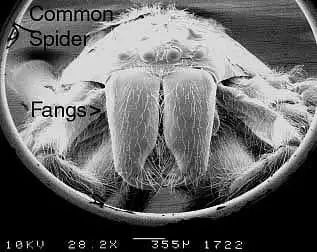
Chelicerae are a pair of appendages that the spider uses to seize and kill its prey. The chelicerae are above the mouth opening and just below the spider’s eyes. At the end of each chelicera is a hard, hollow, pointed claw, and these claws are the spider’s fangs. An opening in the tip of the fang connects with the venom glands so that when a spider bites an insect with its chelicerae, venom flows from the fangs into the wound and paralyses or kills its prey.
In true spiders, the fangs point crosswise, and the venom glands extend back into the cephalothorax. The fangs of tarantulas point straight down from the head, and the venom glands are in the chelicerae. Spiders also crush their prey with their chelicerae. Some species use their chelicerae to dig burrows in the ground as nests. The spiders’ chelicerae can do much more than human teeth ever could.
Pedipalpi
Pedipalps are a pair of appendages that look like small legs. One pedipalp is attached to each side of the spider’s mouth, and they form the sides of the mouth. Each pedipalp has six parts. In most kinds of spiders, the part closest to the body has a sharp plate with jagged edges. The spider uses this plate to cut and crush its food. In adult male spiders, the last part of each pedipalp has a reproductive organ.
Legs
A spider has four pairs of legs, which are attached to its cephalothorax and each leg has seven segments. In most kinds of spiders, the tip of the last segment has two or three claws. Surrounding the claws is a pad of hairs called the scopula. The scopula sticks to smooth surfaces and helps the spider walk on ceilings and walls. Sensitive bristles that serve as organs of touch and perhaps organs of smell also cover each leg. Some bristles pick up vibrations from the ground or air, or the spider’s leg while others detect chemicals in the environment. Spiders detect smell with scent sensitive hairs located on their legs. A sense of taste in their mouth is missing. A spider feels her prey with chemo sensitive hairs on her legs and senses if the prey is consumable. The legs consist of seven segments. Beginning from the body these are in the following order and called coxa, trochanter, femur, patella, tibia, metatarsus and tarsus.When a spider walks, the first and third leg on one side of its body move with the second and fourth leg on the other side. Muscles in the legs make the legs bend at the joints but spiders have no muscles to extend their legs so it is the pressure of the blood in their bodies that makes their legs extend. If a spider’s body does not contain enough fluids, its blood pressure drops, the legs draw up under the body, and the animal cannot walk.
Spinnerets
These are short, fingerlike organs with which the spider spins silk. They are attached to the rear of the abdomen. Most kinds of spiders have six spinnerets, but some may have four or two. The tip of a spinneret is called the spinning field and the surface of each spinning field is covered by as many as a hundred spinning tubes. Liquid silk flows through these tubes from silk glands in the spider’s abdomen to the outside of its body and the silk then hardens into a thread.
Respiratory System
Spiders as a group have two kinds of breathing organs – tracheae and book lungs. Tracheae are found in almost all kinds of true spiders and they are small tubes which carry air directly to the body tissues. In front of the spinnerets in most kinds of true spiders is an opening called the spiracle and air enters the tubes through these openings.
Book Lungs are in cavities in the spider’s abdomen and air enters the cavities through a tiny slit on each side and near the front of the abdomen. Each lung consists of 15 or more thin, flat folds of tissue arranged like the pages of a book. The sheets of tissue contain many blood vessels. As air circulates between the sheets, oxygen passes into the blood. Tarantulas have two pairs of book lungs. Most true spiders have one pair.
Circulatory System
The blood of spiders contains many pale blood cells and is slightly bluish in colour. The heart, is a long, slender tube in the abdomen, and pumps the blood to all parts of the body. The blood returns to the heart through open passages instead of closed tubes, such as those of the human body. If the spider’s skin is broken, the blood quickly drains from its body.
Digestive System
A digestive tube extends the length of the spider’s body. In the cephalothorax, the tube is larger and forms a sucking stomach. When the stomach’s powerful muscles contract, the size of the stomach increases. This causes a strong sucking action that pulls the food through the stomach into the intestine. Juices in the digestive tube break the liquid food into particles small enough to pass through the walls of the intestine into the blood. The food is then distributed to all parts of the body. Food is also pulled through the stomach into a fingerlike cavity called the caeca. Because spiders can store food in the caeca, they can go for long periods of time without eating.
Nervous System
In the cephalothorax is the central nervous system including the brain, which is connected to a large group of nerve cells called the ganglion. Nerve fibres from the brain and ganglion run throughout a spider’s body. The nerve fibres carry information to the brain from sense organs on the head, legs, and other parts of the body. The brain can also send signals through the nerve fibres to control the activities of the body.
Spider’s Silk
Making Silk
Spider silk is made up of protein and forms in the spider’s silk glands. As a group, spiders have seven kinds of silk glands. However, no species of spider has all seven kinds. All spiders have at least three kinds of silk glands, and most species have five. Each kind of gland produces a different type of silk. Some silk glands produce a liquid silk that becomes dry outside the body. Other glands produce a sticky silk that stays sticky. Spider silk cannot be dissolved in water and is the strongest natural fibre known.
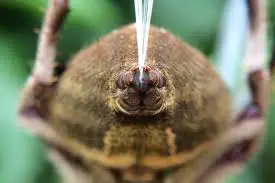
The spinnerets, which spin the silk, work like the fingers of a hand. A spider can stretch out each spinneret, pull it back in, and even squeeze them all together. A spider can use different spinnerets to combine silk from different silk glands and produce a very thin thread or a thick, wide band. Some spiders also can make a sticky thread that looks like a beaded necklace. To do this, the spider pulls out a dry thread that is heavily coated with sticky silk. It then lets go of the thread with a snap. This action causes the liquid silk to form a series of tiny beads along the thread. A spider uses beaded threads in its web to help trap jumping or flying insects.
Some kinds of spiders have another spinning organ called the cribellum. It is an oval plate that lies almost flat against the abdomen, in front of the spinnerets. Hundreds of spinning tubes cover the spinning field of the cribellum. These tubes produce extremely thin threads of sticky silk.
Spiders with a cribellum also have a special row of curved hairs called a calamistrum on their hind legs. Spiders use the calamistrum to comb together dry silk from the spinnerets and sticky silk from the cribellum. This combination of threads forms a flat, ribbonlike silk structure called a hackled band. Spiders use hackled bands in their webs, along with the other silk that they spin.
How spiders use silk
Spiders, including those that do not spin webs, depend on silk in so many ways that they could not live without it. Wherever a spider goes, it spins a silk thread behind itself. This thread is called a dragline. The dragline is sometimes called the spider’s “lifeline” because the animal often uses it to escape from enemies. If danger threatens a spider in its web, it can drop from the web on its dragline and hide in the grass. Or the spider can simply hang in the air until the danger has passed. Then it climbs back up the dragline into its web. Hunting spiders use their draglines to swing down to the ground from high places. Spiders also use silk to spin tiny masses of sticky threads called attachment discs. They use the attachment discs to anchor their draglines and webs to various surfaces.
Many kinds of spiders build silk nests as their homes. Some spiders line a folded leaf with silk to make a nest. Others dig burrows in the ground and line them with silk. Still other spiders build nests in the centre of their webs. Many web-spinning spiders spin sticky bands or wide sheets of silk while capturing their prey. The orb weavers wrap their victims in sheets like mummies so they cannot escape. The female spider of most species encloses her eggs in an egg sac. This sac is a bag made of a special kind of silk.
Types of Spiders
Hunting Spiders: Hunting spiders creep up on their prey or lie in wait and pounce on it. Some kinds of hunters, including jumping spiders and wolf spiders, have large eyes and can see their prey from a distance. But other hunters, such as water spiders, tarantulas, and crab spiders, have small eyes.
The powerful chelicerae of hunting spiders help them overpower their victims. Some hunting spiders spin simple webs that stretch out along the ground and stop insects. These spiders are grouped as hunters because they run after the insects that land in their webs.
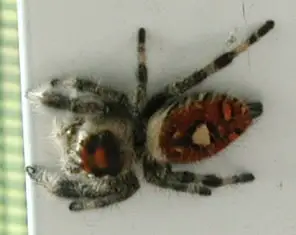
These spiders are all hunting spiders: Jumping spiders creep up and pounce on their prey. These spiders have short legs, but they can jump more than 40 times the length of their bodies. Jumping spiders are the most colourful of all spiders. Many thick, coloured hairs cover their bodies. Most male jumping spiders have bunches of brightly coloured hairs on their first pair of legs.
Water spiders are the only spiders that live most of their life underwater. The water spider breathes underwater from air bubbles that it holds close to its body. Its underwater nest is a silk web shaped like a small bell. The spider fills the web with air bubbles, which gradually push all the water out of the bell. The animal can live on this air for several months. Water spiders are found only in Europe and parts of Asia.
Tarantulas are the world’s largest spiders. The biggest ones live in the South American jungles. Great numbers of tarantulas also are found in the south western United States. Many kinds of tarantulas dig burrows as nests. The trap-door spider covers the entrance to its burrow with a lid. A California tarantula builds a turret (small tower) of grass and twigs at the entrance to its burrow. This spider then sits on the tower and watches for insects moving in the nearby grass. A few kinds of tarantulas live in trees.
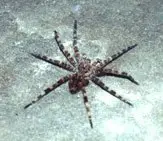
Fishing spiders live near water and hunt water insects, small fish, and tadpoles. These spiders have large bodies and long, thin legs. But because of their light weight, they can walk on the water without sinking. These spiders also can dive underwater for short periods of time. Some fisher spiders are called nursery-web weavers because the female builds a special web for her young.
Crab spiders have short, wide bodies and look like small crabs. They can walk backwards and sideways as easily as crabs do. Some brightly coloured crab spiders hide in flowers and capture bees and butterflies. A few kinds of crab spiders can disguise themselves by changing the colour of their bodies to match the colour of the flower blossom.
Web-spinning spiders
Web-spinning spiders, like hunting spiders, live in caves, in grass or shrubs, or in trees. They cannot catch food by hunting because of their poor vision. Instead, they spin webs to trap insects. A web-spinning spider does not become caught in its own web. When walking across the web, it grasps the silk lines with a special hooked claw on each foot. These spiders are all web-spinning spiders:
Tangled-web weavers spin a web that consists of a jumble of threads attached to a support, such as the corner of a ceiling.
The cellar spiders spin tangled webs in dark, empty parts of buildings. One cellar spider that looks like a daddy longlegs has thin legs more than 5 centimetres long.
The comb-footed spiders spin a tangled web with a tightly woven sheet of silk in the middle. The sheet serves as an insect trap and as the spider’s hideout. These spiders get their name from the comb of hairs on their fourth pair of legs. They use the comb to throw liquid silk over an insect and trap it. The black widow and the Australian redback spider are both comb-footed spiders.
Some spiders spin a tangled web containing a hackled band of dry and sticky silk. The ogre-faced stick spider spins a web that is made up largely of hackled bands. The web is only about as large as a postage stamp. This spider spins a structure of dry silk to hold the sticky web in place. The spider hangs upside down from the dry silk. It holds the sticky web with its four front legs. When an insect crawls or flies near, the spider stretches the sticky web to several times its normal size and sweeps it over the insect.
Funnel-web spiders live in large webs that they spin in tall grass or under rocks or logs. The bottom of the web is shaped like a funnel and serves as the spider’s hiding place. The top part of the web forms a large sheet of silk spread out over grass or soil. When an insect lands on the sheet, the spider runs out of the funnel and pounces on the victim.
Sheet-web weavers weave flat sheets of silk between blades of grass or branches of shrubs or trees. These spiders also spin a net of crisscrossed threads above the sheet web. When a flying insect hits the net, it bounces into the sheet web. Often, an insect will fly directly into the sheet web. The spider, which hangs beneath the web, quickly runs to the insect and pulls it through the webbing. Sheet webs last a long time because the spider repairs any damaged parts. Dwarf spiders, which are less than 1.3 millimetres long, spin small, square sheet webs near rivers and lakes.
Whip or tailed spiders live in Southeast Asia and Australia. They have long, thin, tubelike bodies, 2 to 4 centimetres long. At night the whip spider lets out a few long, thin strands of silk. It then waits for its prey–mainly smaller spiders–to use these silklines as “guide ropes.” When the unsuspecting small spider climbs up such a rope the whip spider snares it by wrapping it in a broad band of silk.
Orb weavers build the most beautiful and complicated of all webs. They weave their round webs in open areas, often between tree branches or flower stems. Threads of dry silk extend from an orb web’s centre like the spokes of a wheel. Coiling lines of sticky silk connect the spokes, and serve as an insect trap.
Some orb weavers lie in wait for their prey in the centre of the web. Others attach a signal thread to the centre of the web. The spider hides in its nest near the web, and holds on to the signal thread. When an insect lands in the web, the thread vibrates. The spider darts out and captures the insect. Many orb weavers spin a new web every night. It takes them about an hour. Such spiders often eat their old webs to conserve silk. Other orb weavers repair or replace any damaged parts of their webs.
Bolus or angling spiders are classed as orb weavers, but they catch flying insects by swinging a silk line with a sticky globule at one end. Some bolus spiders are thought to give off a scent that attracts male moths. Angling spiders have large, cream-coloured bodies with pink, yellow, and brown markings. The magnificent spider of Australia is a type of bolus spider
The Life of a Spider
Each species of spider lives a different life. Many kinds of spiders live for only about a year. Large wolf spiders live several years and some female tarantulas have lived for up to 20 years in captivity. Spiders become adults at different times of the year. Some mature in the autumn, and then mate and die during the winter. Others live through the winter, mate in the spring, and then die.
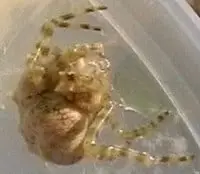
Courtship and Mating
As soon as a male spider matures, it seeks a mate. The female spider may mistake the male for prey and eat him, but most male spiders perform courtship activities that identify themselves and attract the females. The male of some species vibrates the threads of the female’s web. Some male hunting spiders wave their legs and bodies in an unusual courtship dance. Male jumping spiders use the coloured hairs on their legs to signal females. Male nursery web spiders present the female with a captured fly before mating.
Before mating, the male spider spins a silk platform called a sperm web. He deposits a drop of sperm from his abdomen onto the platform. Then he fills each of his pedipalpi with sperm. He uses the pedipalpi to transfer the sperm to females during mating. After mating, the female stores the sperm in her body. When she lays her eggs, several weeks or even months later, the eggs are fertilized by the sperm. Usually, the female does not eat the male after mating as is commonly believed. Females can continue to lay eggs for many months after mating because of the stored sperm.
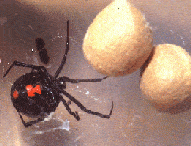
Eggs
The number of eggs that a spider lays at one time varies with the size of the animal. An average sized female lays about 100 eggs but some of the largest spiders lay more than 2,000 eggs. In most species, the mother spider encloses the eggs in a silken egg sac. The sac of each species differs in size and shape. In many species, the mother dies soon after making the egg sac. In other species, she stays with the eggs until they hatch. Some spiders hang the sac in a web. Others attach the sac to leaves or plants. Still others carry it with them. The female wolf spider attaches the sac to her spinnerets, and drags it behind her and then carries the spiderlings on her back after they have hatched.
Spiderlings hatch inside the egg sac and remain there until warm weather arrives. If the eggs are laid in autumn, the spiderlings stay quietly inside their egg sac until spring. After leaving the egg sac, the spiderlings immediately begin spinning draglines.
Many spiderlings travel to other areas. To do this, a spiderling climbs to the top of a fence post or some other tall object and tilts its spinnerets up into the air. The moving air pulls silk threads out of the spinnerets. Then the wind catches the threads and carries the spiderling into the air. This unusual way of travelling is called ballooning. A spider may travel a great distance by ballooning. Sailors more than 300 kilometres from land have seen ballooning spiders.
Spiderlings moult (shed their outer skin) several times while they are growing. A new, larger skin replaces the skin that has grown too tight. Most kinds of spiders moult from five to nine times before they reach adulthood. Tarantulas moult more than 20 times.
Spiders have many enemies including snakes, frogs, toads, lizards, birds, fish, and other animals that also eat insects. Even some insects eat spiders like the wasp which is one of the spider’s worst enemies. One group of spiders called pirate spiders eats nothing but other spiders.
Researched by Stacey (reference source “World Book Encyclopaedia”)
Information and pictures were taken from children’s projects and where credited to that child does not claim to be original information. Where possible, permission to reproduce has been sought. Any infringement of copyright is purely unintentional.